

Specialized Bosch Appliance Repair in San Francisco
Slow drainage is different from no drainage; timing and residual water help narrow the complaint.
If the washer does eventually remove the water, record how long it takes and whether the machine retries the drain before spinning. That information is more useful than simply reporting “drain problem.”
The goal is not to turn an error symptom into a parts guess. A useful troubleshooting process preserves the exact model information, limits checks to accessible owner-level items, and records what changes before and after each safe step. That creates better information for a repair decision and reduces the chance of hiding the original symptom.
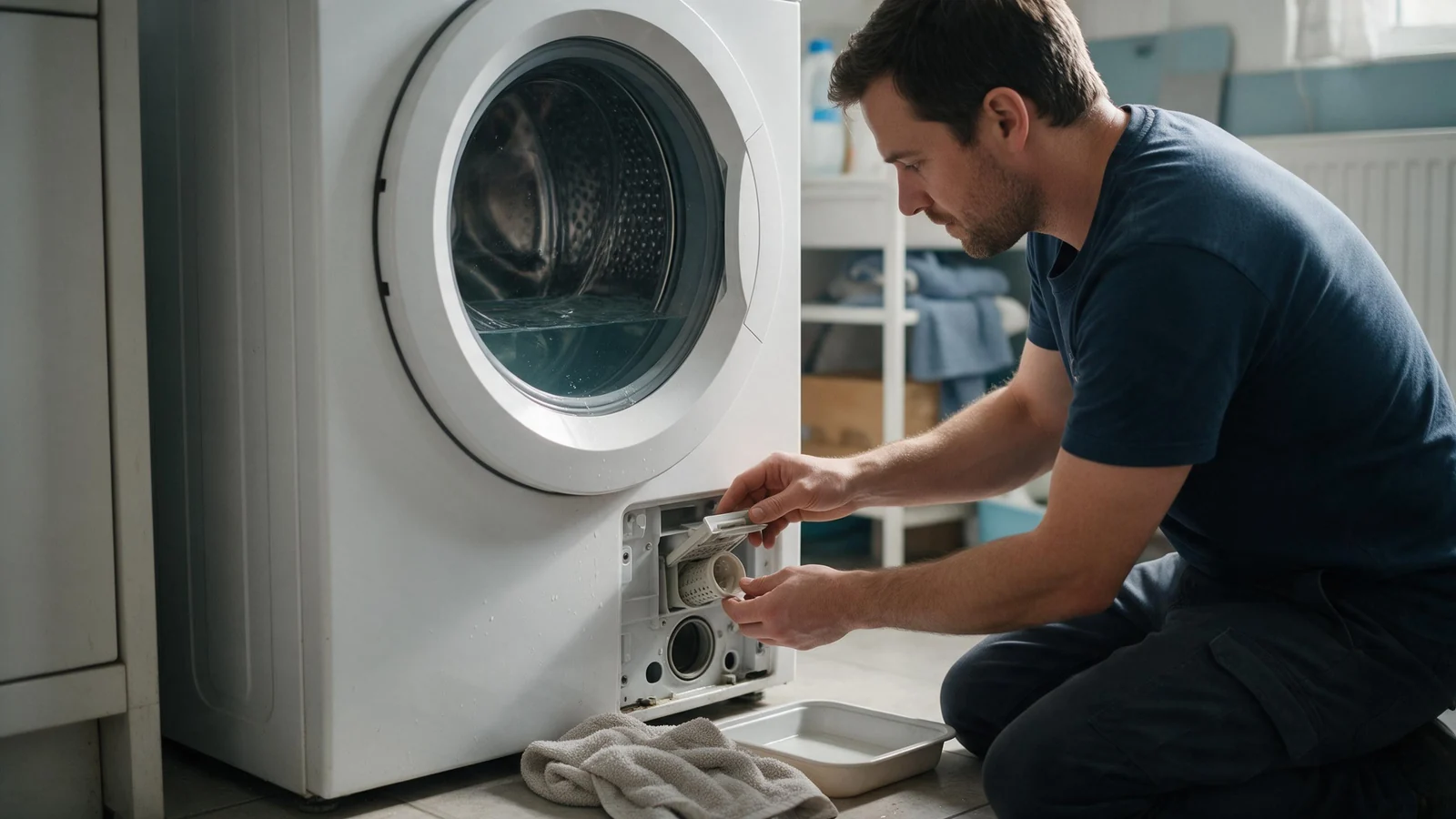
Water removal depends on the pump, user-accessible filter or trap on models that provide one, drain hose routing, household drain connection, sensing, and controls. Safe troubleshooting stays with the visible hose and owner-serviceable access described for the exact model.
Bosch appliance families can share a brand name while using different controls, sensors, pumps, fans, heaters, water systems, or installation requirements. Always use the complete model/E-Nr when matching a symptom to owner documentation, an error-code page, or a service record.
Before resetting the appliance or changing several settings at once, capture the details that make this complaint reproducible:
A short photo, video, temperature reading, cycle-stage note, or description of what changes with the door, load, program, or setting can be more useful than a long list of parts someone thinks might be bad.
Keep these checks external and reversible, and use the exact owner instructions where the model provides a maintenance procedure:
If one of these checks changes the symptom, record exactly what changed. Avoid making several adjustments at the same time; a controlled comparison is easier to interpret than a moving target.
The following steps cross the line from useful homeowner observation into unnecessary risk or can erase diagnostic evidence:
Also stop using the appliance if you encounter smoke, sparking, a burning or electrical odor, active water near electrical components, gas odor, severe overheating, or a protective device that repeatedly trips. Safety conditions take priority over completing a cycle.
Professional diagnosis becomes the sensible next step when the external conditions are normal but the pattern continues. Examples for this symptom include:
At that point, the job is to test the system indicated by the symptom and the exact model—not to replace the most obvious or expensive component on speculation.
For a San Francisco-area service request, prepare the full model/E-Nr, the exact symptom or code, when it occurs, which safe checks were completed, and the service ZIP code. Location references are intentionally light in these technical articles because the repair guidance should remain useful regardless of neighborhood; ZIP code is used to confirm actual coverage and scheduling.
Yes. A restriction can reduce flow while still allowing some water to leave.
Yes. Washers generally need to remove water before normal high-speed spin can proceed.
No. Hose routing, blockage, filter/pump-area conditions, sensing, and controls can create similar symptoms.
Send the model/E-Nr, whether water remains, approximate drain behavior, code, checks performed, and ZIP code.
If the problem described in this guide continues after the safe external checks, request Bosch washing machine diagnosis in the San Francisco service area. Include the complete model/E-Nr, the symptom history, any displayed code, and your ZIP code. service notice: This website represents an appliance repair service. Bosch and related trademarks belong to their respective owners. We are not affiliated with or endorsed by Bosch.
Share a few details and we’ll confirm an appointment. Prefer to talk? Call us and we’ll help right away.
This is not an official Bosch service center.
Fields marked with * are required.